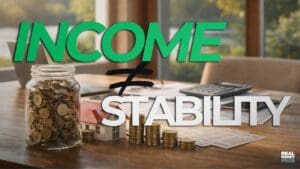
Income Is Not the Same as Stability
One of the most common goals retirees talk about is income. They want money showing up consistently, dividends hitting their account, interest arriving on schedule, and the reassurance that their lifestyle is supported without constant worry. That instinct is completely reasonable. Income feels predictable, tangible, and safe.
But there’s a critical distinction many people don’t recognize until later in retirement: income and stability are not the same thing. Confusing the two can quietly introduce risk into a retirement plan, even when everything appears to be working on the surface.
Income answers the question, “What am I receiving right now?”
Stability answers the question, “Can this plan hold up when conditions change?”
Those are very different questions!
Why Income Feels Safe.
Income feels safe because it’s visible. You can see it arrive in your account, plan around it, and mentally rely on it in the short term. That regularity creates comfort, and comfort often gets mistaken for security.
For many retirees, income replaces the paycheck they relied on for decades. When that steady deposit appears, it recreates the feeling of being “covered.” But that feeling doesn’t always reflect what’s happening underneath the hood.
When retirees say they want income, what they usually mean is that they don’t want to worry about money. That’s not really an income goal. It’s a stability goal.
The Assumption Behind Retirement Income.
There’s an unspoken assumption that if income is coming in, the plan must be solid. But income can exist even when risk is quietly building underneath the surface.
A portfolio can generate income while being exposed to market volatility, rising interest rates, inflation erosion, liquidity constraints, or concentration risk. None of those risks show up clearly just by looking at a monthly payment.
Stability isn’t about whether income shows up this month or next. It’s about whether the plan can continue functioning during market downturns, economic stress, or unexpected life events.
How Income Can Be Unstable.
This is where the difference between income and stability becomes clear.
Imagine a retiree who builds their plan around high-dividend stocks because the quarterly payments feel dependable. During good market years, the income looks great. But during an economic slowdown, companies cut dividends to preserve cash. The income drops at the same time portfolio values decline, forcing withdrawals at lower prices.
Or consider someone using an income-focused mutual fund that pays consistent distributions. Those payments continue, but the fund’s underlying value steadily erodes. On paper, income looks fine. In reality, the retiree is slowly spending down principal without realizing it.
Another example is bond income. Bonds are often viewed as conservative, but when interest rates rise, bond prices can fall. A retiree depending heavily on bond income may still receive payments, but the value of the portfolio declines, reducing flexibility if cash is needed.
Rental income can present similar challenges. Vacancies, repairs, rising insurance costs, or local market changes can interrupt cash flow. Income that once felt stable can suddenly become unpredictable.
In each of these scenarios, income looks reliable until something changes. And when it does, retirees who relied on income alone may be forced to make decisions at exactly the wrong time.
Stability Is About Having Options.
True stability comes from flexibility.
A stable retirement plan provides options when conditions change. Cash reserves can reduce the need to sell investments during market downturns. Multiple income sources can prevent over-reliance on a single strategy. The ability to temporarily adjust spending can buy time when markets or life events don’t cooperate.
Income without flexibility can actually increase risk. When income is locked in, tightly tied to market performance, or dependent on one source, it may feel reassuring day to day but can break under pressure.
Chasing Yield Can Backfire.
It’s common for retirees to reach for higher income in an effort to feel safer. When interest rates rise or high-yield strategies look attractive, it can feel like a logical move.
But higher yield almost always comes with trade-offs.
Those trade-offs may include greater volatility, reduced liquidity, credit risk, or increased sensitivity to economic conditions. None of these are inherently bad, but they must be understood and intentionally managed.
Problems arise when yield becomes the primary objective. In that case, principal risk, inflation risk, and long-term sustainability often get overlooked. Over time, those risks can undermine the very security income was meant to provide.
Income Is a Tool, Not the Goal.
Income works best when it serves a clear purpose within a broader plan. It can support spending needs, reduce pressure on growth assets, and provide consistency when structured correctly. But income by itself is not a retirement strategy.
Stability comes from structure. It comes from knowing which assets are meant to grow, which are meant to provide cash flow, and which are meant to offer flexibility during uncertain periods. Each part of the plan has a job.
When income is layered on top of a thoughtful structure, it supports the plan. When income becomes the structure, the plan often becomes brittle.
Putting Income in Its Proper Place.
A strong retirement plan doesn’t just focus on how much income shows up each month. It focuses on whether the plan can adapt when markets shift, expenses change, or life throws something unexpected your way. The goal in retirement isn’t simply to receive income. It’s to stay in control, even when conditions change.