Which Self-Employed Retirement Savings Plan Should I Choose?
If you’re self-employed or own a small business, you’ve probably wondered: What’s the best way to save for retirement? We get it—there are a lot of options, each with different rules, limits, and benefits. What works for one person may not be ideal for another, and it can all feel overwhelming.
Our team works with many self-employed professionals, and this is one of the most common questions we hear. Plus, when you’re focused on growing your business and doing what you do best, when do you have time to figure all this out?
But taking the time to understand your choices can make a big difference in your long-term financial health. So, let’s break it down.
Why Retirement Planning Matters for the Self-Employed
When you work for a company, you’re often handed a 401(k). But as a business owner or freelancer, it’s on you to build your retirement future. Saving now helps you:
- Take advantage of compound growth
- Potentially reduce your tax bill
- Build flexibility for your future
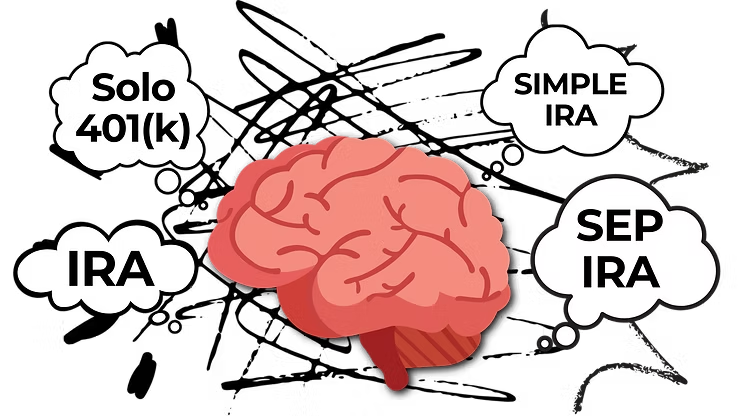
Common Retirement Plan Options for the Self-Employed
1. SEP IRA (Simplified Employee Pension)
- Easy to set up and maintain
- Contribution Limits (2024): Up to $70,000 or 25% of compensation (whichever is less)
- Employer-only contributions
- Tax-deferred growth
- Must contribute the same percentage to all eligible employees
- Employee eligibility:
- Age 21+
- At least 3 years of service in the past 5 years
- Earned at least $750
2. Solo 401(k) / Individual 401(k)
- Available if you have no employees (other than a spouse)
- Contribute as both employee and employer
- Employee deferral: Up to $23,500
- Employer profit-sharing: Up to 25% of compensation
- Total max: Up to $70,000/year
- Catch-Up Contributions:
- Ages 50–59 or 64+: Add $7,500 (total $31,000)
- Ages 60–63: SECURE 2.0 allows $11,250 (total $34,750)
- Roth and Traditional options available
3. SIMPLE IRA (Savings Incentive Match Plan for Employees)
- Designed for small businesses with fewer than 100 employees
- Employee contributions: Up to $16,500 (2025)
- Catch-Up (50+): Add $3,500
- Catch-Up (60–63): SECURE 2.0 allows up to $5,250
- Employer contributions (choose one):
- Match up to 3% of compensation, or
- 2% nonelective contribution (up to $345,000 compensation cap in 2024)
- Easier and more affordable to administer than a 401(k)
4. Traditional or Roth IRA
- Available to anyone with earned income
- Contribution limits (2025):
- Up to $7,000
- $8,000 if age 50+
- Great supplement to another retirement plan
- Roth IRA offers tax-free withdrawals in retirement (if qualified)

What Should You Consider When Choosing a Plan?
Choosing the right plan depends on your business structure, how much you want to contribute, and whether you have employees. Key factors include:
1. How much do you want to save?
- Want to max out savings? A Solo 401(k) typically allows the highest contributions because you contribute as both employer and employee.
- Starting small? A Traditional or Roth IRA is a good first step.
2. Do you have employees—or plan to?
- Truly solo? Consider a Solo 401(k) or SEP IRA.
- Planning to hire?
- SIMPLE IRA is easier to manage with a team.
- SEP IRA requires equal contribution percentages for you and all eligible employees.
3. Do you want Roth vs. Traditional options?
- Solo 401(k) offers both Roth and pre-tax (Traditional) options.
- SEP and SIMPLE IRAs are pre-tax only.
- For tax-free income in retirement, choose a plan with a Roth feature—or pair your main plan with a Roth IRA.
4. How complex do you want the setup and maintenance to be?
- SEP & SIMPLE IRAs: Easy and low-cost.
- Solo 401(k): Offers more features but requires more paperwork (e.g., Form 5500 once assets exceed $250,000).
5. Are you trying to reduce your taxable income this year?
- SEP IRA, SIMPLE IRA, and Traditional IRA contributions are tax-deductible.
- Roth contributions aren’t deductible now—but qualified withdrawals are tax-free.
- Think about your current vs. future tax bracket when deciding.
6. How much control and flexibility do you want?
- Solo 401(k): Offers most flexibility (higher limits, Roth, and loan options)
- SEP IRA: Simple, but less flexible
- SIMPLE IRA: Middle ground, with required employer match rules
Final Thoughts
There’s no one-size-fits-all answer. The right plan depends on your income, goals, tax situation, and whether you plan to grow your business with employees.
Bottom line: Start somewhere. Even a small contribution today can grow into something meaningful. The key is taking action—and adjusting your strategy as your business evolves.
Need help? Contact us – we’re here to help!