Planning for the Year Ahead – The Basics
And like that, 2024 is over… Here’s a breakdown of some key tips and updates to ensure you’re ready to tackle the new year with confidence.
Invest for the long-term and save on taxes
- Maximize your retirement contributions in qualified accounts that are available to you
Individual Retirement Accounts (IRAs)
- Traditional IRA
- Roth IRA
- SEP IRA
- SIMPLE IRA
401(k) Plans
- Traditional 401(k) (Pre-Tax)
- Roth 401(k) (After-Tax)
- Solo 401(k)
Health Savings Accounts (HSAs)
- HSAs offer a triple tax benefit: contributions are pre-tax, investments grow tax-free, and withdrawals are tax-free when used for qualified medical expenses
- Funds are investable, allowing for your money to grow in the long-term
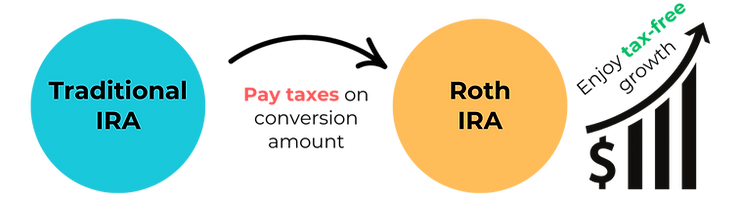
Roth Conversions
- Many provisions of the Tax Cuts and Jobs Act are to sunset at the end of 2025 if not renewed by the incoming administration
- Benefits of Roth Conversions:
- Tax-Free Growth: All future growth in the Roth IRA is tax-free, which can mean big savings over time
- Tax-Free Withdrawals in Retirement: In retirement, withdrawals are tax-free, which can help you control your tax rate
- No Required Minimum Distributions (RMDs): Roth IRAs don’t require you to take withdrawals at a certain age, so your money can keep growing longer
- Good for Estate Planning: Roth IRAs can be inherited tax-free by your beneficiaries, allowing more wealth transfer to heirs
Tax Loss Harvesting: Capturing Losses Against Gains
Using the Loss to Offset Gains
-
- If you have a $1,000 loss from one stock and a $1,000 gain from another, the loss cancels out the gain, so you don’t pay taxes on the $1,000 gain
- Capital losses exceeding capital gains can be used to offset capital gains or as a deduction against ordinary income up to $3,000 in any one tax year
- Losses exceeding that $3,000 can be carried over into the following tax year and so on
Example: Bob sells Stock ABC at a $6,000 loss and Stock DEF at a $2,000 gain.
- The $2,000 gain is fully offset by $2,000 of the loss, leaving Bob with a $4,000 remaining loss
- Bob uses $3,000 of the remaining losses to reduce his taxable income for the year
- He can carry over that remaining $1,000 loss to reduce next year’s taxable income
Beware of Wash Sales
- You cannot repurchase the same or a “substantially identical” investment within 30 days of the sale – doing so would lead to a wash sale
Some Changes To Know For 2025:
Contribution and Income Limits for Qualified Retirement Accounts
Here are important changes to know about qualified retirement accounts in 2025:
- The annual contribution limit for employees who participate in 401(k) plans increased to $23,500, up from $23,000
- Catch-up contributions for these plans remain at $7,500, making limits for those age 50 and older $31,000
- A higher catch-up contribution limit applies for employees aged 60, 61, 62 and 63 who participate in these plans – limit is $11,250
- The limit on annual contributions to an IRA remains $7,000 for 2025.
- The catch-up amount for those age 50 and older remains $1,000 for the year – $8,000
- SIMPLE IRA contribution limit raised to $6,500 for 2025
- Catch-up for those age 50+ remains $3,500 – $10,000
- Roth IRA income limits have increased for 2025
- Phase-out ranges for Traditional IRA deduction eligibility also increase for 2025
Federal Marginal Rates for 2025

Data Source: Internal Revenue Service. “IRS Releases Tax Inflation Adjustments for Tax Year 2025.” Last modified October 19, 2024. Accessed December 13, 2024. https://www.irs.gov/newsroom/irs-releases-tax-inflation-adjustments-for-tax-year-2025.
Standard Deductions
- For single taxpayers and married individuals filing separately for tax year 2025, the standard deduction rises to $15,000 for 2025
- For married couples filing jointly, the standard deduction rises to $30,000
- For heads of households, the standard deduction will be $22,500 for tax year 2025
If you have questions or need guidance on implementing these tips, please reach out to your financial advisor. Strategies listed above may not be suitable based on your financial situation.