1099 Reporting Issues That May Cause You to Pay More Tax Than Necessary
With the federal filing deadline for 2025 individual returns set for April 15, 2026, many taxpayers are doing what they do every year: gathering 1099s, uploading PDFs, and assuming the forms tell the whole story. Often, they do. But when retirement-account transactions are involved, that assumption can sometimes lead to confusion about how those transactions should be reported.
The issue is not that Form 1099-R or Form 1099-B is inherently incorrect. Rather, these forms typically report what occurred mechanically, not necessarily the full context of the transaction. Money may have left an account. Securities may have been sold. A distribution may have occurred. But transactions such as a direct rollover, Roth conversion, non-deductible IRA contribution, or certain employee stock transactions may require additional reporting steps for the tax return to reflect the transaction correctly.
That distinction matters because tax software and tax preparers generally rely on the information they receive. If the context surrounding a transaction is unclear, a non-taxable movement of funds may appear similar to a taxable distribution. In some situations, that could lead to overstated income or incorrect basis reporting.
Why Form 1099-R Trips People Up
Form 1099-R is used to report distributions from pensions, annuities, IRAs, 401(k)s, and other retirement plans. If funds leave one of these accounts, a 1099-R is typically generated—even if the transaction itself is not taxable.
This includes rollovers. According to IRS guidance, when a retirement-plan distribution is rolled over into another eligible retirement account, the transaction is generally not taxable at that time. However, the movement of funds is still reportable on the tax return.
In other words, “not taxable” does not mean “not reported.”
In practice, a taxpayer may roll money from a former employer’s 401(k) into an IRA and receive a 1099-R reflecting that distribution. If the rollover is not properly reflected on the tax return as a rollover transaction, the distribution could appear similar to ordinary income when viewed in isolation.
The Backdoor Roth Reporting Issue
This reporting nuance becomes even more important with backdoor Roth strategies.
A high-income taxpayer who is not eligible to contribute directly to a Roth IRA may instead make a non-deductible contribution to a traditional IRA and subsequently convert those funds to a Roth IRA.
The strategy itself is permitted under current tax rules, but the reporting must be handled carefully.
The IRS requires Form 8606 to report:
- Non-deductible contributions to traditional IRAs
- Distributions from IRAs when after-tax basis exists
- Conversions from traditional, SEP, or SIMPLE IRAs to Roth IRAs
Form 8606 allows the IRS to track which IRA dollars have already been taxed.
If Form 8606 is omitted or completed incorrectly, the tax return may overstate the taxable portion of the Roth conversion. In situations where after-tax contributions are involved, improper reporting could result in the same dollars potentially being taxed again.
There is also a timing consideration relevant during tax season. IRA contributions designated for the 2025 tax year may still be made until April 15, 2026. However, the reporting of those contributions and any related Roth conversions must be handled correctly on the tax return to reflect the proper tax treatment.
The “I Sent Everything to My CPA” May Not Always Be Enough
Many filing issues are not the result of negligence. They often stem from missing context.
A preparer may correctly enter the forms they receive, yet still need additional information if they are not aware that:
- a 1099-R represents a direct rollover, not a withdrawal
- an IRA contribution was non-deductible
- a Roth conversion followed that contribution
- a stock sale reported on Form 1099-B involved employee compensation affecting cost basis
Providing context for unusual transactions can help ensure the tax return accurately reflects what occurred.
For example, including a short note such as:
- “This 1099-R represents a rollover from a 401(k) to an IRA”
- “This IRA contribution was non-deductible and later converted to Roth”
can help reduce ambiguity when preparing the return. While this is not a requirement under IRS rules, it can be a practical way to ensure transactions are interpreted correctly during preparation.
Employee Stock Compensation Can Add Complexity
These issues are not limited to retirement accounts. Employee stock compensation can also create situations where the tax reporting spans multiple forms.
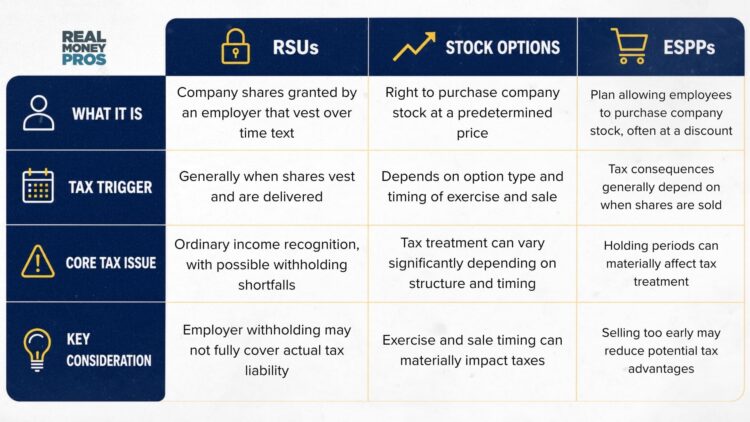
Stock options and employee stock purchase plans (ESPPs) may generate a combination of:
- ordinary income
- capital gains
- or both
depending on the structure of the plan and when the shares are sold.
For example, certain ESPP sales are reported on Form 1099-B, but a portion of the income may already have been included as compensation elsewhere, such as on a Form W-2.
In these cases, the cost basis shown on the 1099-B may not fully reflect the tax treatment required on the return. IRS guidance allows adjustments to be made when reporting the sale on Form 8949 if the basis reported on the 1099-B does not reflect the full tax situation.
This is one reason employee stock transactions often require additional review compared with routine brokerage trades.
Timing Matters During Tax Season
Another practical issue involves the timing of tax documents. Not all information returns are issued simultaneously.
For example, certain brokerage statements—such as Forms 1099-B—may be furnished later than other tax documents due to the complexity of cost-basis reporting.
Additionally, financial institutions sometimes issue corrected 1099 forms if adjustments are required after the original statement is sent.
Because of this, filing immediately after receiving the first batch of tax documents may occasionally lead to the need for an amended return if additional or corrected information is issued later.
What to Review Before Filing
Before submitting a return for the 2025 tax year, it may be helpful to review any documents connected to:
- IRA contributions
- Roth conversions
- 401(k)-to-IRA rollovers
- large retirement distributions
- employee stock plan sales
- Form 1099-B transactions where the reported cost basis appears inconsistent
Key questions to consider include:
- Was the IRA contribution deductible or non-deductible?
- Was the distribution a withdrawal or a rollover?
- Did the sale of employer stock include compensation income?
- Is Form 8606 required to track after-tax IRA contributions?
- Are adjustments needed on Form 8949 to reflect the correct cost basis?
Summary
Most tax reporting issues related to Forms 1099 are not dramatic. They often arise from subtle differences between how a transaction is reported on an information return and how it ultimately should appear on the tax return.
A rollover may look like a distribution. A Roth conversion may appear larger than the taxable portion actually is. A brokerage form may show a cost basis that requires adjustment once compensation income is considered.
Because these details are not always obvious from the forms themselves, reviewing unusual transactions before filing can help ensure the return accurately reflects the activity that occurred.
With the April 15, 2026 filing deadline approaching for 2025 returns, taxpayers who experienced retirement account movements, Roth conversions, or employee stock transactions may benefit from confirming how those events are reflected on their return before submitting it.