When Your Business Outgrows Your Retirement Plan
There’s a point in most businesses where things start to change. Revenue is up. Margins are improving. Cash flow is consistent. You’re no longer trying to figure out if the business will work—you’re focused on improving it.
That’s usually when a new problem shows up. Taxes!
What worked when you were making $80,000 or $120,000 a year doesn’t always work when income increases meaningfully. One of the most common places this shows up is your retirement plan.
Many business owners start with a SIMPLE IRA.
It’s easy to set up, it’s inexpensive, and it checks the box. But at a certain point, it stops doing what you need it to do.

Where SIMPLE IRAs Start Breaking Down
A SIMPLE IRA works well… until it doesn’t.
The issue isn’t just lower contribution limits. It’s how those limits interact with rising income.
At a certain stage:
- Contributions are maxed out early in the year
- Income continues to grow
- Tax liability increases, but deferral options do not
The structure isn’t scaling with the business.
This is where the disconnect becomes clear: operationally, things have improved—but the planning tools haven’t kept pace.
The Contribution Gap Most People Miss
This is where the difference becomes meaningful.
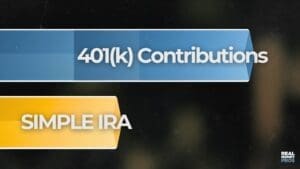
At a high level, here’s what that difference looks like in 2026:
- SIMPLE IRA total contributions typically fall in the $20,000–$25,000 range for many business owners, depending on income and employer contributions
- A properly structured 401(k), including profit sharing, can allow for $60,000+ in total contributions, and in some cases up to ~$70,000+
At higher income levels, the difference between modest deferral and greater tax planning flexibility becomes increasingly material.
Over time, that gap can become more meaningful. Not just in savings, but in tax efficiency.
What Actually Changes With a 401(k)
Transitioning to a 401(k) isn’t simply about contributing more… It introduces flexibility.
With the right structure, you may be able to:
- Increase total annual contribution capacity
- Adjust employer contributions based on profitability
- Coordinate retirement contributions with broader tax planning
- Create optionality in how income is managed year-to-year
Instead of a fixed framework, the strategy can evolve alongside the business.
What the Transition Actually Looks Like
For many business owners, the hesitation isn’t the strategy, it’s the process. A 401(k) sounds more complex than a SIMPLE IRA, and to some extent, it is. But in practice, the transition is usually more manageable than expected.
At a high level, it typically involves:
- Selecting a plan provider
- Designing the plan structure, including contribution flexibility
- Coordinating with payroll and recordkeeping
- Ongoing administration and compliance support
For businesses already operating at a higher level, this tends to be an operational adjustment—not a fundamental hurdle.
Not All 401(k)s Are the Same
It’s also worth noting that “401(k)” isn’t a single structure.
For example:
- Individual (Solo) 401(k)s are typically used by business owners with no employees
- Traditional 401(k)s are designed for businesses with staff and come with additional compliance requirements
The appropriate structure depends on how the business is set up and whether employees are involved.
A Real-World Shift
This pattern shows up frequently. A business owner establishes a SIMPLE IRA early on for its simplicity and low cost.
Several years later:
- Revenue has grown
- Profitability has improved
- Cash flow is stable
But the retirement plan remains unchanged.
The business is operating at a higher level, while the planning structure reflects an earlier stage. The result is often predictable: higher tax exposure and fewer available planning options.
When the Cost Actually Makes Sense
Cost is one of the primary reasons business owners stay in a SIMPLE IRA.
A 401(k) introduces:
- administrative oversight
- compliance requirements
- ongoing costs that may run a few thousand dollars per year
Viewed in isolation, that can feel like a disadvantage.
A more useful way to evaluate it is this:
What is the potential value of increased flexibility and tax deferral?
If a plan costs $3,000 to $5,000 annually but allows for significantly more tax-efficient contributions, the tradeoff often becomes more compelling.
Not in every case, but frequently enough to justify a closer look.

When It’s Worth Taking a Closer Look
There’s no need to change plans prematurely.
However, it’s worth evaluating if:
- Income has increased meaningfully
- Contribution limits are consistently being reached
- Tax liability feels disproportionate to available planning tools
- Greater flexibility in contribution structure would be beneficial
These are typically indicators that the current plan may no longer be aligned with the business.
Final Thought
The objective isn’t complexity—it’s alignment!
A SIMPLE IRA can be an effective starting point.
But as income grows, the cost of remaining in a structure that no longer fits can become more significant than moving to a different structure.
Next Step
If your income has evolved or your current retirement plan isn’t providing the flexibility you expected, it may be worth taking a closer look at your options.
The team at The Real Money Pros can help evaluate whether your current structure still fits and what adjustments may be appropriate moving forward.