Asset Location: Why Where You Hold Your Investments Matters

Investors spend a great deal of time deciding what to own.
Which funds should make up the portfolio? How much should be allocated to stocks versus bonds? Should international markets play a larger role? Is there enough diversification? Are investment costs reasonable?
Those are important questions. But as wealth accumulates across different types of accounts, another question becomes increasingly important:
Where should those investments actually be held?
The same investment can behave very differently from a planning perspective depending on whether it is held in a taxable brokerage account, a Traditional IRA, a 401(k), or a Roth account.
The underlying investment hasn’t changed.
But the way its income and gains are taxed, the planning opportunities available along the way, and eventually the way those assets can be used to fund retirement may be very different.
That distinction is known as asset location. And while it receives considerably less attention than asset allocation, it can become an important part of building a tax-aware investment and retirement strategy.
Asset Allocation and Asset Location Solve Different Problems
Most investors are familiar with asset allocation.
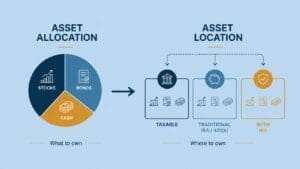
Asset allocation answers the question: What should I own?
It determines how a portfolio is divided among stocks, bonds, cash, and other investments based on factors such as risk tolerance, time horizon, income needs, and financial goals.
Asset location answers a different question:
Where should I own it?
Over time, many households accumulate money across several types of accounts. There may be a workplace retirement plan, Traditional IRAs, Roth accounts, taxable brokerage accounts, and additional accounts belonging to a spouse.
Those accounts may all hold investments, but they don’t all operate under the same tax rules.
In a taxable brokerage account, dividends, interest, and realized capital gains can create current tax consequences. Traditional IRAs generally allow earnings and gains to compound tax-deferred, with taxable distributions generally included in income later. Roth IRAs receive no upfront deduction, but qualified distributions can be tax-free (Internal Revenue Service, Publication 590-B).
That means choosing an investment and choosing where to hold that investment are really two separate decisions.
And as a portfolio becomes larger and more complex, coordinating those decisions can matter.
The Same Investment Can Create Different Planning Opportunities
One of the easiest ways to understand asset location is to look at what happens when an investment declines.
Suppose an investor owns the same stock fund in two different accounts: a taxable brokerage account and a Traditional IRA. The fund falls significantly in both.
Economically, the investment experience may be identical.
From a tax-planning perspective, it isn’t.
Selling the investment at a loss inside the taxable account may create a capital loss that can be used to offset capital gains, subject to applicable tax rules. If total capital losses exceed capital gains, individuals generally may deduct up to $3,000 of net capital losses against other income annually, with unused losses potentially carried forward to future years (Internal Revenue Service, “Topic No. 409”).
The decline inside the IRA doesn’t create that same current tax benefit because earnings and gains within a Traditional IRA generally aren’t taxed until distributed (Internal Revenue Service, Publication 590-B).
Same investment. Same market decline. Different planning opportunities.
The distinction can work the other way as well.
Certain investments already receive preferential tax treatment. Interest from U.S. Treasury securities, for example, is subject to federal income tax but exempt from state and local income taxes. Interest from qualifying state and municipal obligations is generally exempt from federal income tax, although exceptions and additional rules can apply (Internal Revenue Service, Publication 550).
Holding investments with existing tax advantages inside an account that already provides tax deferral may reduce the usefulness of those particular advantages. Whether that makes sense depends on the investor’s circumstances, expected returns, available investment choices, risk profile, and overall portfolio.
That’s why asset location isn’t simply a matter of memorizing which investment “belongs” in which account.
The account itself should be part of the investment decision.
Taxable Accounts Aren’t Necessarily the “Bad” Bucket
It’s easy to look at a taxable brokerage account and see only what it lacks.
There is no upfront tax deduction for making a contribution. Investment income may create current taxes. Selling an appreciated position can generate capital gains.
Compared with a retirement account, that may sound inherently inefficient.
But taxable accounts can offer something extremely valuable: Flexibility.
Investors generally have control over when appreciated investments are sold and gains are realized. Capital losses may create opportunities to offset gains. Appreciated securities may potentially be incorporated into charitable giving strategies. And money can generally be accessed without the retirement-account distribution rules that apply to IRAs and employer plans.
That flexibility can become particularly valuable later in life.
A retiree who has accumulated nearly all of their investable wealth inside pre-tax retirement accounts may have a substantial portfolio, but withdrawals from those accounts will generally create taxable income.
Another retiree with wealth spread among taxable, tax-deferred, and Roth accounts may have more choices about where the next dollar of retirement income comes from.
Neither structure is automatically superior.
But one may provide more levers to pull when circumstances change.
In Retirement, Asset Location Becomes an Income Decision
During the accumulation years, the focus is typically on saving and investing.
Retirement changes the question!
Instead of asking only: “How much do I have?”
Retirees eventually have to ask: “Where is my paycheck going to come from?”
This is where asset location begins to intersect with withdrawal strategy.
Suppose a retired household needs an additional $50,000 for a major home repair. They have enough money. That’s not the problem. The question is which money to use.
A $50,000 withdrawal from a Traditional IRA could increase taxable income. Selling investments in a taxable brokerage account could realize capital gains or losses. A qualified Roth IRA distribution may provide tax-free cash, but spending Roth assets also means giving up assets that otherwise could continue growing in a tax-advantaged environment. Cash may create little or no immediate tax consequence, but drawing it down too aggressively could weaken the household’s liquidity position.
The same $50,000 expense can therefore have several different financial consequences depending on how it is funded.
And those consequences may extend beyond the current year’s tax bill.
Higher modified adjusted gross income can also affect Medicare Part B and Part D premiums through the Income-Related Monthly Adjustment Amount, commonly known as IRMAA. Medicare generally uses modified adjusted gross income reported on an individual’s federal income tax return from two years earlier when determining whether an income-related adjustment applies (Centers for Medicare & Medicaid Services).
Suddenly, “Where should the $50,000 come from?” isn’t simply a banking question. It becomes a retirement-income planning decision.

Tax Diversification Creates Options
Investment diversification is widely understood, but tax diversification receives far less attention. Yet having assets subject to different forms of taxation can create valuable flexibility over a retirement that may last twenty or thirty years.
There may be years when recognizing additional ordinary income from a Traditional IRA is relatively attractive. There may be other years when income is already elevated because of a business sale, large capital gain, Roth conversion, Required Minimum Distribution, or some other event.
The appropriate source of additional spending may change from year to year and sometimes paying taxes sooner is the better decision.
A retiree in a temporarily lower tax environment, for example, might intentionally recognize additional income rather than automatically trying to minimize the current year’s tax bill. Another retiree may preserve Roth assets for later years when taxable income is expected to be higher. Someone else may benefit from realizing capital gains in a year when doing so fits efficiently within the broader tax picture.
None of those decisions can be made simply by looking at which investment has performed best. They require understanding how the accounts interact. The objective isn’t necessarily to pay the least tax in any single year.
It’s to make thoughtful decisions about taxes over the course of the entire plan.
Asset Location Isn’t About Chasing Tax Efficiency
There is an important caution here… Taxes matter, but they should not dictate every investment decision. A portfolio still has to accomplish its primary job.
It needs an appropriate level of risk. It needs sufficient diversification. It may need to generate income. It may need liquidity. And it needs to reflect when and how the money will eventually be used.
A theoretically tax-efficient asset-location strategy that compromises diversification, creates unnecessary concentration, or makes a portfolio difficult to manage isn’t necessarily an improvement.
This is the familiar principle of not letting the tax tail wag the investment dog.
Asset allocation comes first because the portfolio still needs to be built around the investor.
Asset location then asks whether that portfolio can be distributed among available accounts more thoughtfully – it’s all about coordination.
Three Questions, Not One
For most of an investor’s life, portfolio management tends to revolve around one question: What should I own?
As the financial picture becomes more complex, two more questions become increasingly important:
Where should I own it? And eventually, Where should I spend from?
Those are three different decisions. Asset allocation determines the portfolio’s investment mix. Asset location considers how those investments should be distributed among accounts with different tax characteristics.
Withdrawal strategy determines how those accounts may eventually work together to create retirement income, but the real planning value comes from coordinating all three.
Summary
There is no universally perfect asset-location strategy.
The appropriate structure depends on an investor’s tax circumstances, income, time horizon, risk tolerance, liquidity needs, retirement goals, estate objectives, available account types, and the investments themselves. But once meaningful wealth has accumulated across taxable, tax-deferred, and Roth accounts, evaluating each account in isolation can miss the larger picture.
The portfolio isn’t simply a collection of statements. Eventually, those assets need to fund a life. And at that point, success isn’t determined solely by what the investments earned. It can also be influenced by how those assets were structured, how they’re taxed, and how much flexibility the investor has when it’s time to use them.
What you own matters.
Where you own it matters, too.
And eventually, where you spend from may matter just as much.
Are Your Accounts Working Together?
As wealth accumulates, financial planning often becomes less about adding another investment and more about making sure the pieces already in place are working together.
Taxable accounts, Traditional retirement accounts, and Roth assets each have different characteristics and can play different roles within a long-term financial plan. Coordinating asset location with investment strategy, tax planning, and retirement income can help create greater flexibility as circumstances change.
If you’ve accumulated assets across several different types of accounts and aren’t sure whether they’re working together efficiently, we’d be happy to take a look.
Visit our Find an Advisor page to connect with one of our fiduciary advisors. Our team can help evaluate your investments in the context of your broader financial picture and identify planning opportunities that may be worth discussing with your financial and tax professionals.
Works Cited
Centers for Medicare & Medicaid Services. 2026 Medicare Costs. U.S. Department of Health and Human Services, 2026. Medicare.gov, accessed 12 Aug. 2026.
Internal Revenue Service. Publication 550: Investment Income and Expenses. U.S. Department of the Treasury, 2025. IRS.gov, accessed 12 Aug. 2026.
Internal Revenue Service. Publication 590-B: Distributions from Individual Retirement Arrangements (IRAs). U.S. Department of the Treasury, 2025. IRS.gov, accessed 12 Aug. 2026.
Internal Revenue Service. “Topic No. 409, Capital Gains and Losses.” U.S. Department of the Treasury, IRS.gov, accessed 12 Aug. 2026.