A Retirement Projection Is Not a Retirement Plan
Retirement calculators have become one of the most common tools investors use to gauge their readiness for retirement. Enter a few assumptions, estimate future spending, click a button, and receive a probability of success.
For many people, that number becomes a source of confidence. If the projection says the plan works, retirement feels achievable. If the score looks weak, concern follows.
The problem is that retirement outcomes are rarely determined by a projection alone.
Consider two retirees. Both are 65 years old. Both have a $3 million portfolio. Both want to spend $120,000 per year in retirement. Both receive a projection showing a high probability of success.
On paper, they appear virtually identical.
Ten years later, however, one household may have significantly more after-tax wealth, greater flexibility, and fewer future tax concerns than the other.
Not because they earned higher returns.
Not because they took more risk.
But because they made different planning decisions along the way.

The Illusion of Precision
Retirement calculators are not inherently bad. In fact, they can be extremely useful.
They help establish a baseline. They can model different retirement dates, spending assumptions, and market environments. They can help investors understand whether they are generally moving in the right direction.
The issue is that many investors begin treating the projection as the plan itself.
A retirement calculator primarily evaluates assets and assumptions. Real retirement planning involves decisions. And those decisions often have a far greater impact on long-term outcomes than people realize.
A calculator might tell you that your retirement has an 85% probability of success. What it typically doesn’t tell you is how to improve the outcome, reduce taxes, create more flexibility, or adapt to changing circumstances over time.
That is where planning begins.
Where Real Planning Creates Value
One of the biggest misconceptions in retirement planning is that investment performance is the primary driver of success.
While returns certainly matter, many retirees discover that tax decisions, income decisions, and withdrawal decisions can be equally important.
Take Roth conversions as an example. Two retirees may have identical IRA balances entering retirement. One gradually converts portions of those assets to a Roth IRA over several years while remaining within favorable tax brackets. The other waits and allows future Required Minimum Distributions to dictate the timing.
The portfolios started in the same place, but the long-term tax consequences may look dramatically different. Future RMDs, Medicare premiums, survivor tax situations, and overall tax efficiency can all be affected by those decisions.
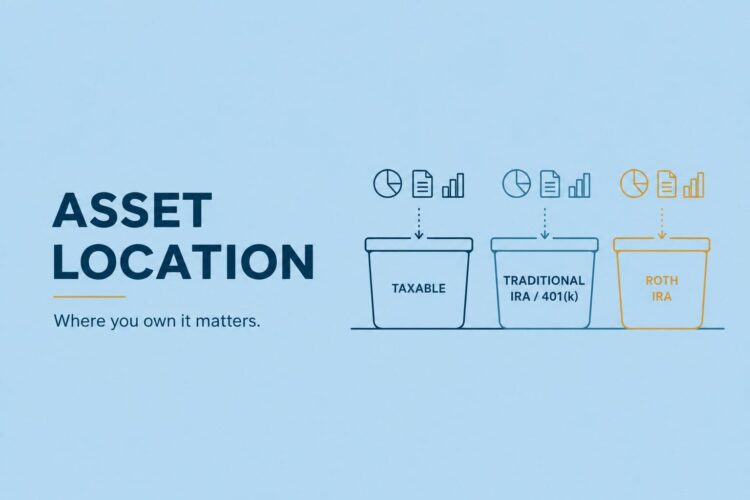
The same concept applies to withdrawal sequencing. Many retirees own a combination of traditional IRAs, Roth IRAs, and taxable brokerage accounts. Where retirement income comes from matters. Drawing from one account instead of another may affect tax brackets, capital gains exposure, Medicare surcharges, and future planning opportunities.
Social Security presents another example. The decision is often framed as whether to claim early or delay benefits. In reality, the better question is how Social Security fits into the broader retirement income strategy. Factors such as taxes, portfolio withdrawals, spousal benefits, and longevity expectations can all influence the optimal approach.
Even Medicare planning can become a meaningful consideration. Many retirees are surprised to learn that higher income levels can increase Medicare premiums through Income-Related Monthly Adjustment Amounts, commonly known as IRMAA. Strategic decisions involving Roth conversions, stock sales, capital gains, and withdrawals can all influence those costs.
Most retirement calculators acknowledge that these variables exist. Few meaningfully evaluate how coordinated planning decisions may improve the outcome.
The Variables No Calculator Can Predict
Perhaps the biggest limitation of any projection is that it assumes a relatively predictable future.
Real life rarely cooperates.
A child may need financial assistance. A business may be sold. An inheritance may arrive unexpectedly. Healthcare costs may change. Tax laws may evolve. Spending patterns may look nothing like the assumptions originally entered into the calculator.
These events often have a far greater impact on retirement than a slight difference in projected returns.
A calculator cannot anticipate those changes.
Planning adapts to them.
That distinction is important because retirement is not a one-time event. It is an ongoing process that may last twenty or thirty years. The most successful retirement plans are rarely the most accurate projections. They are the most adaptable.
Why Retirement Planning Becomes More Complex Than Many People Expect
As retirement approaches, planning often becomes less about accumulating assets and more about coordinating decisions.
There are more moving parts. More account types. More tax considerations. More opportunities to improve outcomes. And unfortunately, more opportunities to make costly mistakes.
This is why many retirees discover that an online calculator only tells part of the story.
The complexity is not necessarily found in the investments themselves. It is found in coordinating taxes, income sources, healthcare costs, estate considerations, charitable goals, concentrated positions, and spending decisions into a cohesive strategy.
In many cases, the greatest opportunities are not hidden inside the portfolio. They are hidden inside the planning.
The Better Question
Many investors ask a reasonable question:
“What is my probability of success?”
There is nothing wrong with that question.
But it may not be the most valuable one.
A better question is:
“What decisions could improve the outcome?”
Because retirement success is rarely determined by a single projection. It is shaped by hundreds of decisions involving taxes, withdrawals, healthcare costs, investment strategy, and spending over the course of retirement.
The projection may establish the starting point.
The decisions that follow often determine where you finish.
Final Thought
Retirement calculators can be incredibly useful tools. They help investors understand where they stand and whether their assumptions are realistic.
What they typically cannot do is identify opportunities.
They cannot tell you when a Roth conversion may make sense. They cannot coordinate withdrawal strategies. They cannot evaluate the broader impact of tax decisions, Medicare costs, or changing life circumstances.
Those are planning decisions.
And for many retirees, those decisions may have a greater impact on long-term outcomes than the projection itself.
Because retirement planning is not simply about determining whether a plan works.
It’s about making informed decisions that help the plan work better.
Next Step
If you’ve built a retirement plan around a projection, it may be worth asking a different question:
What opportunities might be missing?
Whether it’s Roth conversions, withdrawal sequencing, Social Security timing, tax planning, or simply pressure-testing the assumptions behind your plan, small adjustments can sometimes create meaningful improvements over time.
If you’d like a second set of eyes on your retirement strategy, visit our Find an Advisor page and we’ll connect you with an advisor who is well-suited to your situation.