Blocking out the Noise

Eric Sterner, CFA, CAIA, FRM, CIPM
Chief Investment Officer, Apollon Wealth Management and Apollon Financial
November 16, 2026
________________
There’s a lot of noise in the markets right now. Then again, that’s not a new trend. It seems like every political, stock market, and/or sports TV show consists of two to four people on the screen yelling at each other. Instilling fear is sometimes a media tactic to grab consumers’ attention. That tactic was on display over the past few weeks as volatility is increasing in the markets. On November 5th, the NASDAQ index closed down 5.52% while the S&P 500 finished 4.4% lower. The headlines for the day included phrases such as “Massive Tech Sell-Off”, “Stocks Plunge as Dem Midterm Sweep Fuels AI Regulatory Concerns”, and “Dow Plunges” to name a few. The heightened volatility was further fueled when Jensen Huang resigned as CEO of Nvidia which is one of the biggest companies in the world and has been at the center of this powerful AI transformation. These stories may have caused increased anxiety amongst some investors on top of the war in the Middle East, elevated inflation, rising bond yields, and the possibility of more rate hikes from the Fed.
Heightened anxiety can sometimes lead to emotional investing decisions, which can be detrimental to investors achieving their financial goals. My barometer of investors’ anxiety is sometimes how many texts / calls I receive from family and friends during these periods of market turmoil. My advice to them is to take a deep breath and focus on the facts. So let’s take a few steps back and reassess where we are.
Divided Government – A Good Sign for the Markets?
First, we are in a polarizing political environment and unfortunately, I don’t see that changing anytime soon. However, what we can do is block out the noise when others are predicting dooms day due to elections results. The midterm election results saw the Democrats regain the majority for both the Senate and the House. This result produced a divided government, which is defined as when one political party holds the executive branch and a different political party controls one or both chambers of the legislative branch. That’s usually good news for the markets. Divided governments typically produce more gridlock in government, and there is less uncertainty as major legislation changes are less likely. Since 1970, the S&P 500 has averaged returns of 14.4% the year after mid-term elections resulted in divided governments.
It’s also important to remember that both political parties have witnessed times of significant growth as well as declines during their periods of majority rule. In looking at the chart below, there does not appear to be a pattern of stronger returns for either party. The markets have historically continued to provide returns over the long term regardless of which party is in power at any given time.
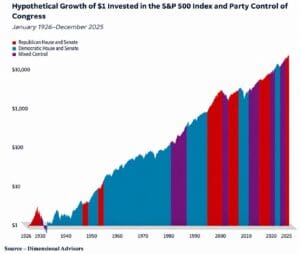
Source – Dimensional Advisors
The Mid-Term Elections and the AI Trade
While the market was down two days after the election, some commentators painted the narrative that the AI Trade is dying as Democrats seem to have more resistance to datacenter construction. There are certainly some concerns that datacenters may increase consumers’ utility bills and/or cause more noise and air pollution, which is why it was a major theme in the mid-term campaigns. I believe there could be advantages to slightly slowing down these datacenter constructions to ensure that communities are not adversely affected. Datacenters can also bring benefits to communities through increased tax revenue / public services, more jobs, and infrastructure enhancements. The AI movement is a worldwide race, and I don’t believe any political party wants the US to fall behind China from a technology perspective.
I would also note that it can be a fool’s game to predict which sector(s) will outperform or underperform based upon election results. While politicians may have some impact on market returns, so do many other factors including interest rate changes, technological advances, corporate profits, economic growth, consumer spending and the labor markets to name a few. As an example, when President Trump won his first election, some investors bet that energy would be a top performing sector due to Trump’s “Drill, baby, drill” motto. However, between 2017 – 2020, energy was the worst performing sector. When Joe Biden won his Presidential election, some of those same investors thought energy would underperform, yet energy was the top performing sector between 2021 – 2024.
Back to Fundamentals
While headlines and sometimes even tweets can temporarily move the markets, it’s important to remember over the long-term, market returns are most heavily influenced by the fundamentals. And the fundamentals look great. As of November 13, the S&P 500’s earnings growth rate is 31.9%, which would mark the third-straight quarter of earnings growth above 25% for the index. Over the past 20 years, such a streak has only happened twice (in 2009 – 2010 and in 2021), and both of those strong earnings growth rates were due to the economy bouncing back from a recession. While earnings are expected to slow down in 2027, the S&P 500’s projected growth rate is still a very healthy 16.2% as of today. Additionally, the valuation of the S&P 500 as measured by its forward PE ratio is improving due to earnings growth exceeding the total return of the index for 2026. In fact, the S&P 500 forward PE ratio is now below both its 5-year average and 10-year average.
Rising Yields Planting the Seeds of Future Fixed Income Returns
This past 3rd quarter was a painful one for fixed income investors. Bond yields jumped higher and the 10-year Treasury eclipsed 5% for the first time since 2007. For the quarter, the Bloomberg US Aggregate Bond index was down 3.51%. While it was not a welcome development on some fronts, it did plant the seeds for great opportunity in the fixed income markets. With the 10-year still near 5%, the case for adding duration is stronger than it has been in nearly two decades. For high-quality bonds, the yield at purchase has historically been the best single guide to total return over a multi-year holding period. We may see interest rates remain volatile going forward and the Fed may hike again next month, but that increase is already priced into yields. Bond price swings in the interim are just noise around an income stream that is now substantial. Investors may be tempted to wait for the Fed to cut rates, but by that time, yields have usually already fallen.
Diversification is an Investor’s Best Friend
The best defense to market volatility is diversification. While Technology has been the spotlight due to this powerful AI movement, it’s important to remember of other opportunities in the markets. All 11 sectors are expected to produce earnings growth in the 3rd quarter and as of today, 6 out of 11 sectors have generated year-to-date market returns above 10%. In our Apollon models, we diversify across market capitalizations, geography, sectors, and other asset classes such as real estate and commodities. Remain disciplined to your financial goals and always place more emphasis on the fundamentals as opposed to the noise. Political views should be expressed in the polls, but not in portfolios.
Eric Sterner
CFA, CAIA, FRM, CIPM
Important Disclosures
Apollon Wealth Management, LLC and Apollon Financial, LLC (collectively, “Apollon”) are affiliated investment advisers separately registered with the U.S. Securities and Exchange Commission (“SEC”). Registration with the SEC does not imply a certain level of skill or training.
Apollon provides investment advisory services based on each client’s individual objectives, financial circumstances, and needs. For clients who have granted discretionary authority, the applicable Apollon advisory firm is authorized to make investment decisions on the client’s behalf in accordance with the client’s advisory agreement.
The information contained herein is provided for informational and educational purposes only and should not be construed as personalized investment, legal, accounting, or tax advice, or as a recommendation to buy or sell any security or implement any investment strategy. Investors should consult their financial, legal, or tax professionals regarding their individual circumstances before making financial decisions.
Investing involves risk, including the possible loss of principal. Diversification and asset allocation do not ensure a profit or protect against loss in declining markets. Past performance does not guarantee future results.
Any opinions, projections, forecasts, estimates, or forward-looking statements are based on assumptions believed to be reasonable as of the date presented, are subject to change without notice, and should not be relied upon as guarantees of future events or investment results.
Information obtained from third-party sources is believed to be reliable; however, Apollon does not independently verify such information and does not warrant its accuracy or completeness. References to indices are provided for illustrative purposes only. Investors cannot invest directly in an index, and index performance does not reflect fees, expenses, or transaction costs.
Additional information regarding Apollon Wealth Management, LLC and Apollon Financial, LLC, including each firm’s Form ADV, is available at:
https://apollonwealthmanagement.com/
Copyright 2026 Apollon Wealth Management