Your Portfolio May Be Less Diversified Than You Think
Why the number of funds you own doesn’t always tell you how diversified your investments really are.
Imagine opening your retirement account and seeing three investments: an S&P 500 index fund, a total U.S. stock market fund, and a large-cap growth fund.
Different names, different strategies, and potentially hundreds or even thousands of stocks represented across those investments. At first glance, that might seem like a well-diversified portfolio.
But look at the companies inside those funds, and you may find something interesting. Several of the largest holdings could be the same.
You might own Nvidia through all three funds. The same could be true of Apple, Microsoft, or other large companies. Without ever purchasing those stocks individually, you could have a meaningful portion of your retirement savings invested in a relatively small group of businesses.
That doesn’t automatically make your portfolio inappropriate. In fact, there may be perfectly reasonable explanations for those exposures.
The issue is whether you understand how much you own and, more importantly, whether that exposure fits what you’re trying to accomplish.
Owning more funds doesn’t necessarily mean owning more diversified investments.
Why the S&P 500 Doesn’t Give Every Company an Equal Say
The S&P 500 is one of the most widely followed measures of the U.S. stock market. It includes 500 leading companies and represents a substantial portion of the market value of publicly traded U.S. businesses.
But those companies don’t contribute equally to the index.
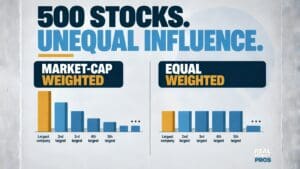
The S&P 500 uses a methodology called float-adjusted market-capitalization weighting. Put simply, companies with larger market values generally receive larger weights in the index.
If one company represents 7% of an index and another represents 0.1%, a comparable percentage move in the larger company will have a much greater effect on the index’s return.
This structure has some practical advantages. It allows an index to reflect the relative market values of its constituent companies without requiring investors to continually decide which businesses deserve greater emphasis.
It also means that when a relatively small group of companies becomes exceptionally valuable, those companies can account for an increasingly significant portion of the index.
This isn’t necessarily a problem that needs fixing. Investors holding a market-cap-weighted fund participate in the performance of those companies in proportion to their index weights.
But it is important to understand what that means for the overall portfolio.
A fund can hold hundreds of companies and still be heavily influenced by the performance of its largest holdings.
Three Funds, One Company: How Overlap Adds Up
Let’s look at a hypothetical example.
Suppose you have a $600,000 investment portfolio divided equally among three funds:
|
Investment |
Amount Invested |
|
S&P 500 index fund |
$200,000 |
|
Total U.S. stock market fund |
$200,000 |
| Large-cap growth fund |
$200,000 |
| Total portfolio |
$600,000 |
Now assume a particular company represents the following percentages of each fund:
|
Investment |
Hypothetical Company Weight | Your Exposure |
|
S&P 500 index fund |
7% |
$14,000 |
|
Total U.S. stock market fund |
6% |
$12,000 |
|
Large-cap growth fund |
12% |
$24,000 |
| Combined exposure | – |
$50,000 |
Although you’ve divided your investments among three funds, approximately $50,000, or 8.3% of your portfolio, is exposed to the same company.
And that’s before accounting for any shares you might own directly or through other investments.
(These figures are hypothetical and are intended to illustrate how overlapping holdings can affect portfolio concentration. They do not represent the current holdings of any particular fund.)
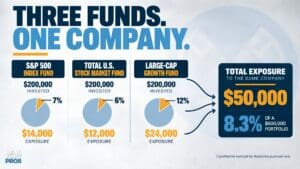
Here’s what makes this exercise valuable: nothing about the individual funds necessarily changed. Each may be operating exactly as intended.
It’s the combination of investments that creates the exposure.
This is why reviewing a portfolio fund by fund can produce a different impression than reviewing all of its underlying holdings together.
Different Funds Can Still Depend on Similar Outcomes
Individual-company overlap is only one part of the picture.
Consider two funds that don’t hold exactly the same companies. One emphasizes large technology businesses, while another invests in companies supplying equipment, electricity, or infrastructure to data centers.
The funds may have relatively little direct overlap. Yet both could be influenced by changes in expectations for artificial intelligence spending.
That doesn’t mean the companies have identical risks or will perform the same way. Their businesses, valuations, and sources of revenue may be quite different.
But it demonstrates an important distinction: different holdings don’t always mean independent risks.
The same principle applies beyond technology.
A portfolio might hold several investments that are particularly sensitive to interest rates, consumer spending, commodity prices, or economic growth. Those exposures may become more apparent when market conditions change.
That’s why diversification is worth examining through several lenses, including individual companies, industries, investment styles, company sizes, and geographic markets.
It also helps to distinguish diversification within stocks from diversification across asset classes. Even a broadly diversified stock portfolio remains exposed to the risks of the stock market. Bonds, cash, and other assets may serve different purposes, although each carries risks of its own.
The objective isn’t to eliminate every common exposure. That’s neither practical nor possible.
It’s to understand which risks you’re taking and whether they serve a purpose.
Could Equal Weighting Make a Difference?
One way investors can change their exposure to the largest companies is through an equal-weighted index strategy.
Unlike the traditional S&P 500, which gives greater weight to larger companies, the S&P 500 Equal Weight Index assigns approximately the same weight to each constituent company at its quarterly rebalancing.
That means the largest companies have considerably less influence than they do in the traditional market-cap-weighted version.
However, equal weighting introduces its own trade-offs.
It increases relative exposure to the smaller companies within the S&P 500 and changes the portfolio’s sector and investment-style characteristics. It also requires periodic rebalancing, which can affect turnover, expenses, and potentially taxes depending on how the strategy is implemented.
An equal-weighted approach may outperform when market leadership broadens, but it may lag when the largest companies continue to drive returns.
Neither approach is inherently better for every investor.
And importantly, switching from market-cap weighting to equal weighting does not eliminate stock-market risk.
The useful question isn’t which version of the S&P 500 will perform better next year. It’s whether the exposure created by either approach is appropriate for the role it plays in your portfolio.
Before Changing Investments, Ask What the Money Is For
This is where a conversation about diversification becomes a conversation about financial planning.
Imagine two investors holding identical portfolios.
One is 40 years old, contributing regularly to retirement accounts, and doesn’t expect to withdraw the money for another 25 years.
The other is 68, recently retired, and expects to use a portion of the portfolio to supplement Social Security and pension income.
They own the same investments, but the money has very different responsibilities.
The younger investor may be comfortable accepting significant stock-market volatility in pursuit of long-term growth.
The retiree may need to consider how market declines could affect planned withdrawals, particularly during the early years of retirement.
That doesn’t automatically mean the retiree should own fewer stocks or avoid companies with large index weights. The appropriate allocation depends on other income sources, spending needs, available cash reserves, investment objectives, and the ability to tolerate losses.
But it illustrates why diversification can’t be evaluated in isolation.
A portfolio isn’t simply a collection of investments intended to generate returns. Those investments are supposed to support specific financial objectives.
The risk worth taking is the risk that serves the plan.
A concentrated allocation might be intentional and appropriate. It might also be an exposure that accumulated gradually as certain investments appreciated or new funds were added over time.
Either way, the decision should be based on the overall financial picture rather than a reaction to recent market performance or headlines.
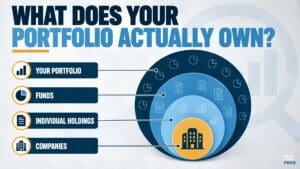
How to Find Out What You Actually Own
You don’t need specialized software to begin evaluating your portfolio. A useful first review can be done with your account statements and the holdings information published by your funds.
Start with the funds themselves. Find the ticker symbols for your mutual funds and ETFs. Visit the fund providers’ websites and review their published holdings and allocations. Pay attention to the reporting dates, since holdings and weights can change.
Look for companies appearing more than once. If you see the same large companies across several funds, calculate how much exposure you have to each through those investments.
For example, if you have $100,000 invested in a fund and one company represents 5% of its holdings, your indirect exposure to that company is approximately $5,000. Repeat that calculation for any other funds containing the same company, then add any shares you own directly.
Review the entire household portfolio. Your 401(k), IRA, Roth IRA, and taxable brokerage accounts may all contribute to the same exposures. Reviewing accounts separately can overlook how those positions combine.
Consider what you might be missing. Are your stock investments concentrated in U.S. large-cap companies? Do you have meaningful exposure to smaller companies or international markets? Are several funds pursuing similar investment styles?
Connect the findings to your financial plan. An investment allocation that made sense when you began accumulating assets may deserve another look as retirement approaches, your income changes, or your financial goals evolve.
None of this means you necessarily need to sell anything.
In some cases, the existing portfolio may already be appropriate. In others, future contributions, rebalancing, or changes to investment selections may help address unwanted concentrations.
Before making adjustments, consider taxes, transaction costs, investment restrictions, and the role each account plays in your overall plan.
The objective is to make informed decisions, not to create unnecessary portfolio activity.
Diversification Is About Exposure, Not Appearances
It’s possible to own a single broad-market fund and have a reasonable foundation for long-term investing. It’s also possible to own a dozen different funds and discover that many of them depend on the same companies or economic conditions.
Neither the number of funds nor the number of individual securities tells the whole story.
What matters is how the investments work together.
The S&P 500’s concentration in its largest companies is a characteristic of how the index is constructed. It doesn’t automatically make the index unsuitable, and it doesn’t mean investors should abandon it when market leadership becomes narrow.
But it does provide a useful reason to look more closely at the investments already in your accounts.
You may discover that your portfolio is well aligned with your objectives. You may find some overlap that you’re comfortable maintaining. Or you may identify exposures you didn’t realize had become so significant.
Any of those findings can lead to a more informed investment decision.
The goal isn’t to own more investments. It’s to understand what you own, why you own it, and what those investments need to accomplish.
Does Your Portfolio Still Fit Your Financial Plan?
As retirement accounts and investment portfolios grow, it can become increasingly difficult to see how individual holdings contribute to the overall strategy.
A comprehensive portfolio review can help identify overlapping investments, unintended concentrations, and opportunities to better align investment risk with your financial objectives.
Visit The Real Money Pros to connect with a fiduciary financial advisor!
________
Works Cited
S&P Dow Jones Indices. “S&P U.S. Indices Methodology.” S&P Global. https://www.spglobal.com/spdji/en/methodology/article/sp-us-indices-methodology/.
S&P Dow Jones Indices. “S&P 500 Equal Weight Index.” S&P Global. https://www.spglobal.com/spdji/en/indices/equity/sp-500-equal-weight-index/.
S&P Dow Jones Indices. “The S&P 500 and the Dow.” S&P Global. https://www.spglobal.com/spdji/en/research-insights/index-literacy/the-sp-500-and-the-dow/.
Financial Industry Regulatory Authority. “Concentrate on Concentration Risk.” FINRA. https://www.finra.org/investors/insights/concentration-risk.